
Padel vs Pickleball: What’s the Difference? A Simple Guide for Indian Players
If you just walked into the sports club in Mumbai, Delhi or Bangalore the opportunity to hear: “Let’s play padel!” or “How about booking a game of pickleball!” Happens on a daily basis, however, what is the difference between these two sports? When asking about padel vs pickleball in India – which one do I play?
This guide is easy to understand, very helpful, and perfect for beginners.
What Is Padel and Pickleball?
What is Padel?
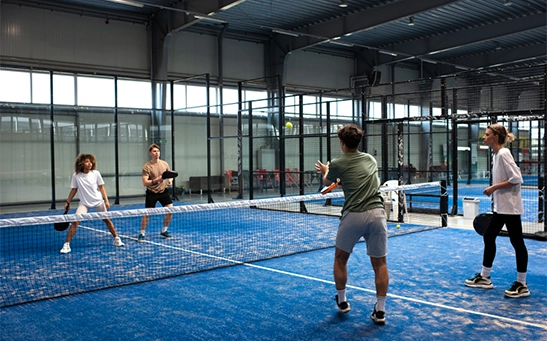
Padel (also known as paddle) is a sport that combines elements of both Tennis and Squash. The game is always played as doubles and is played on a court that is fully enclosed with glass walls. The walls can be used during a game, making it a strategic and entertaining game.
What is Pickleball?
Pickleball is another racket-based game that combines aspects of both tennis and badminton, but it can also include elements of table tennis, as it is a paddle sport. The size of the court is smaller than a tennis court, and it is generally an easy game to learn and very much geared toward socializing while playing.

Brief History
Padel
In 1969, Enrique Corcuera created the sport of padel in Mexico. Padel has been exceedingly successful in Spain and Argentina and is now making its way into the Middle East and also entering into high-end clubs in India.
Pickleball
Pickleball originated in 1965 in the United States. Pickleball has become extraordinarily popular in the United States, particularly among the elderly; it then evolved into a recreational sport globally. The expansion of pickleball in India is presently at a much faster rate than padel because of a lot lower start-up cost.
Court Size, Dimensions & Personality
Seeing as both sports have very different court designs, comparing them offers us an insight into the character of each sport.

Padel Court
- Size: 20m x 10m
- Enclosed with glass walls
- Only doubles
- Fast-paced, strategic, powerful
Padel feels premium. It’s energetic and tactical because you can use the walls to return the ball.
Pickleball Court
- Size: 13.4m x 6.1m
- Open court (like a badminton court)
- Singles or doubles
- Slower, more placement-based
Pickleball feels accessible. It’s social, easy to pick up, and less physically demanding.
Type of Rackets
Padel Racket
- Solid without Strings
- Heavier than pickleball paddles
- Have a shorter handle
- Have no Strings

Pickleball Paddle
- Are lightweight
- Have a flat Surface
- Are made of composite materials or graphite

The differences in equipment typically represent a large part of the overall differences between the two sports (padel rackets being typically more powerful than pickleball paddles; paddles giving more control).
Ball Type
Padel Ball
A padel ball looks similar to a tennis ball but is slightly less pressurized. This lower pressure allows for better control and longer rallies, especially when playing off the glass walls.
Pickleball Ball
A pickleball ball is made of durable plastic and features multiple small holes (similar to a wiffle ball). These holes reduce speed and create a more controlled, placement-based game.

The pickleball balls move slower due to the holes. The padel ball behaves more like tennis, especially when rebounding off walls.
Rules & Scoring
Padel
- Tennis-style scoring (15-30-40-game)
- Always doubles
- Walls can be used after the bounce
Pickleball
- Games usually go up to 11 points
- Must win by 2
- Includes a “non-volley zone” (kitchen rule) near the net
These rule differences clearly define the difference between padel and pickleball, especially for new players deciding where to start.
Let’s Simplify The Game
How Is Padel Different From Pickleball?
Feature | Padel | Pickleball |
Court | Enclosed with walls | Open |
Format | Only doubles | Singles & doubles |
Ball | Tennis-like | Plastic with holes |
Energy | High intensity | Moderate intensity |
Skill curve | Strategic | Easy to learn |
You can easily understand the difference between padel and pickleball using the table and confidently explain it in just 30 seconds.
Which One Should You Play?
The choice between the two depends on your personality type and fitness goals.
Play Padel If
- You like playing energetic rallies
- You enjoy playing strategic and team-based games
- You like playing in a club setting with proper organization
- You want to gain a competitive advantage
Play Pickleball If:
- You are a beginner in racket sports
- You want to play a social and casual game
- You like playing in flexible formats
- You want to learn a game that is easy to learn
A comparison of padel and pickleball does not reveal which is “better” – it merely indicates which style fits best for you. It is all about being comfortable, your personal preference for the game, and your ability to continue playing pickleball long term.